


Walk into a big airport like JFK or Atlanta for the first time and you’ll see signs pointing to terminals, concourses, gates, and piers. They sound like they mean similar things, but they don’t. Mixing them up is how people end up at the wrong gate with five minutes to boarding.
Here’s the airport concourse vs terminal vs gate breakdown so you can move through any airport without panicking. Once you know what each one means, the signs actually start making sense.
The short version: a terminal is a whole building, a concourse is a wing inside that building, and a gate is the actual door you walk through to board your plane.
Table of Contents
What Is an Airport Terminal?

Think of an airport terminal as its own self-contained mini-airport inside the bigger complex. Each terminal has its own check-in counters, security, baggage claim, and gates.
Atlanta has five terminals. JFK has six. Heathrow has four. Smaller airports often have just one. Big international hubs are basically a cluster of separate airports that share the same name.
Airports split into terminals because it’s easier to manage. Running one building with 50 flights a day is simpler than running one giant building with 300. It also means you don’t have to walk a mile to your gate, which is what would happen if everything was under a single roof.
Here’s the part that trips people up: terminals can be 20 to 40 minutes apart by shuttle. At LAX or JFK, getting from Terminal 1 to Terminal 5 means a bus ride or a long walk between buildings. Before you leave for the airport, check your boarding pass and confirm which terminal your flight leaves from.
If you’re connecting at a giant airport, you might also need to change terminals between flights. Build that time in or you’ll be sprinting.
Read Next: Airport Travel Terminology 101
What Is an Airport Gate?
A gate is the actual spot where you board the plane. It’s the corridor or door that connects the terminal to the aircraft. Each gate has a flight info screen, a desk for the gate agent, and a waiting area with seats.
After you check in and clear security, you’re looking for your gate. A typical terminal has anywhere from 10 to 100 gates depending on the size of the airport. The big ones (Atlanta, O’Hare, DFW) easily have 50+ gates per terminal.
Gates usually open about 30 to 40 minutes before departure. If your flight leaves at 2:00 PM, boarding starts around 1:25 or 1:30. The gate agent scans your boarding pass when it’s your turn.
Pro tip: gate numbers change more often than you’d think. Always check the airport screens, not just the gate number on your boarding pass. I’ve had gates switch three times before boarding on a single trip. The airline app usually pushes a notification, but the screens are the source of truth.
Tip: Airports are huge, and getting to your gate from check-in often takes 30 minutes or more. If you want to skip baggage claim and avoid checking fees, travel carry-on only. I use the [amazon link=”B07BM9DFX9″ title=”Maxlite 5 international fabric carry-on”] and it’s held up for years. With a personal item too, I can pack two to three weeks of stuff in there.
What Is an Airport Concourse?
Some terminals are big enough that they get split further into concourses. A concourse is a long, rectangular section of the terminal that holds a group of gates, usually 10 to 20 of them.
Concourses are almost always labeled with letters. A terminal might have Concourse A (gates 1-20), Concourse B (gates 21-40), Concourse C (gates 41-60), and so on. If your gate is 44, you’d follow signs to Concourse C, then walk to gate 44.
Why split things up like this? Two reasons. First, it makes the terminal easier to navigate since you only need to find your concourse instead of scanning every single gate. Second, airports often dedicate certain concourses to international flights so they can put customs and immigration in just one spot instead of spreading it everywhere.
Atlanta is the classic example. ATL has seven concourses (T, A, B, C, D, E, F) connected by an underground train. That train is the only realistic way to get between them in time. If you’re flying through Atlanta, factor in 10 to 15 minutes just for the train ride between concourses.
Read Next: How Long Can You Stay In an Airport?
What Is an Airport Pier?
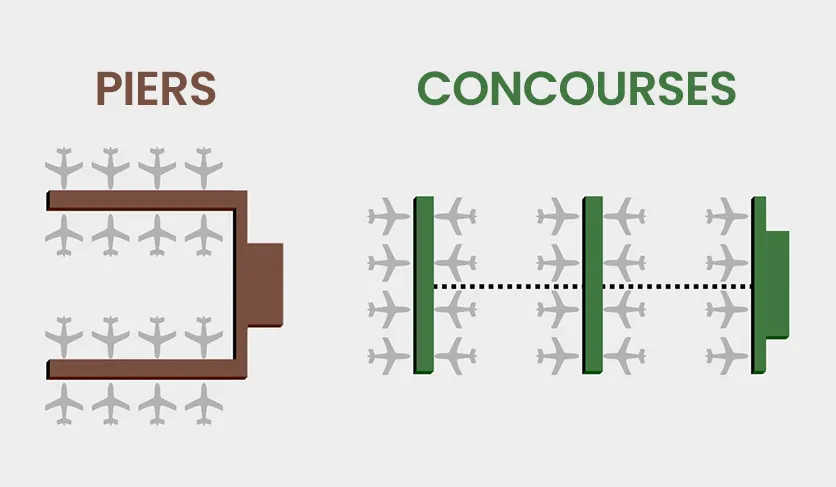
For most travelers, piers and concourses are basically the same thing. They both group gates together so you can find the right one faster.
The technical difference is how they connect to the rest of the airport. Concourses link to other concourses through buses, trains, or tunnels. Piers connect directly to a central building at one end, like fingers on a hand.
You don’t need to memorize this difference. Treat piers like concourses and you’ll be fine. The airport signage tells you what to do.
Read Next: Can You Go Through Airport Security Without a Ticket?
Airport Concourse vs Terminal vs Gate: Quick Reference
Here’s the cheat sheet you can mentally pull up at any airport:
- Terminal: A whole building inside the airport with its own check-in, security, and baggage claim. Most airports have 1 to 6.
- Concourse: A long wing inside a terminal that holds a group of gates. Usually labeled by letter (A, B, C).
- Pier: Same function as a concourse, just connected differently. Treat them the same.
- Gate: The actual door you board through. Each terminal has between 10 and 100 of them.
A Simple Way to Remember the Difference
Picture a huge shopping mall with multiple buildings spread across a property. Each building is a terminal. Inside each building, the stores are arranged in long rows. Each row is a concourse. Each individual store is a gate.
Or if parking lots make more sense to you: the airport is the whole parking complex. Each terminal is a separate lot (Lot A, Lot B). Each lot has rows (concourses). Each row has individual parking spaces (gates).
Once it clicks, you’ll never get confused again. The names are just labels for layers of the same hierarchy.
Planning Tips for Big Airports
If you’re flying out of a major hub, do these three things and you’ll save yourself a lot of stress:
1. Check the terminal before you leave home. Most boarding passes show this clearly, but some airline apps bury it. If you only see a flight number, look it up on the airline app or the airport’s website.
2. Add 20 to 30 minutes for terminal transfers. Atlanta, JFK, LAX, ORD, and DFW are all large enough that getting from one terminal to another takes time. Shuttles don’t always run on schedule.
3. Don’t trust gate numbers. Gates change. Always look at the airport screens when you arrive, not just your boarding pass. The airline app usually catches changes too, but screens are faster.
When in doubt, ask. Airport staff would much rather point you in the right direction than peel you off the floor in tears at the wrong gate.
Read Next: Why Some Airports Are Called International and Others Domestic