


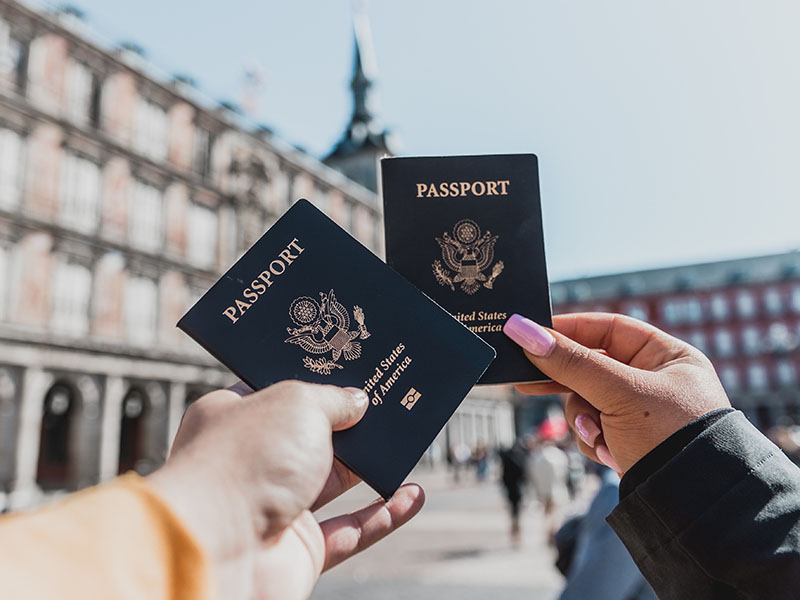
You’ll need your passport at multiple points during a trip: entering and exiting countries, checking into hotels, and renting a car. Losing it abroad isn’t just inconvenient. It can derail your entire vacation and cost you days at the embassy.
Here’s how to keep your passport safe while traveling, plus the right way to carry your documents, cards, and cash so a single theft doesn’t strand you.
Table of Contents
Should You Always Keep Your Passport on You When Traveling?
Carrying your passport everywhere has real risks: theft, accidental loss, leaving it on a restaurant table. The fewer hours it’s on you, the lower your odds of losing it.
That said, most countries legally require travelers to carry valid identification at all times. Random ID checks on the street are rare, but if one happens and you don’t have anything, you can be fined or briefly detained. So in most situations, your passport (or a photocopy plus your driver’s license, depending on the country) needs to be on you.
The smarter question isn’t whether to carry it, but how to carry it so theft and loss are unlikely.
How to Carry Your Passport Safely While Traveling

1. Use a Hidden Neck Wallet (And a Decoy Wallet)
The single best move for passport safety is splitting your stuff between a visible wallet and a hidden one. The visible wallet (your normal one) carries small amounts of cash and a low-limit debit card. That’s what gets handed over if you’re mugged.
The hidden one carries the real valuables: passport, primary credit cards, and the bulk of your cash. A [amazon link=”B017AHHFNK” title=”Zero Grid Travel neck wallet”] is what most experienced travelers use. It hangs around your neck under your shirt, and pickpockets literally can’t reach it without you noticing.
The two-wallet approach also protects against digital card scams. Your low-balance debit card is the one going into sketchy ATMs, hotel front desks, and rental car counters. Your real card stays hidden.
2. Don’t Keep Family Passports Together
The biggest passport safety mistake families make is stacking everyone’s documents in one bag. One stolen wallet, one misplaced backpack, and the whole family is suddenly stranded.
Split passports across adults. Each adult should ideally carry their own [amazon link=”B017AHHFNK” title=”hidden neck wallet”]. If one gets stolen, the rest of the family can still travel and help replace what’s lost.
3. Make Photocopies and Email a Scan to Yourself
Before you leave, make 2-3 photocopies of your passport and email a digital scan to yourself. Keep the photocopies separate from the actual passport (in your luggage, your other bag, or with your travel partner).
If your passport gets stolen, the embassy can issue a replacement faster when you have a copy. Local police also accept the photocopy as proof of identity while you wait for a new one.
One safety tip: write “PHOTOCOPY ONLY: For replacement purposes” across the top of any printed copies. This makes them useless for opening bank accounts, taking out loans, or other identity theft if they fall into the wrong hands.
4. Add Emergency Contact Info Inside Your Passport
If you get into an accident or someone finds your lost passport, having an emergency contact inside speeds up the response. Slip a small piece of paper into a [amazon link=”B091T5Y524″ title=”passport cover”] with:
- Emergency contact name
- Phone number with country code
- Email address
- Any critical medical info (allergies, conditions)
Read Next: 30 Things to Do Before Traveling Abroad + Printable Checklist
5. Use Hotel Safes (and Verify They Work)
Most hotels and Airbnbs offer in-room safes. Some hotels also have a main safe at reception. Either is significantly safer than leaving your passport in a desk drawer or backpack.
Test the safe before storing anything: open and close it twice with the code you set. Cheap hotel safes have been known to lock permanently after one use, and you don’t want that with your passport inside.
Worth knowing: technically, you’re supposed to carry valid ID with you at all times in most countries. Some travelers leave their passport in the safe and carry only a photocopy plus a driver’s license when they’re out. This is technically illegal in many countries but rarely enforced. Your call on the risk.
6. Register Your Trip With Your Government
The U.S. State Department’s Smart Traveler Enrollment Program (STEP) lets U.S. citizens register their trips with the local embassy in 5 minutes. Other governments offer similar services (the UK has GOV.UK travel registration, Canada has the Registration of Canadians Abroad).
Why it matters: in case of natural disasters, terrorist attacks, political unrest, or major emergencies, the embassy knows you’re in country and can reach you. They also send safety updates while you’re traveling.
Note down the embassy’s address and phone number too. If your passport gets stolen, you’ll want to walk straight there.
7. Keep Your Passport Dry and Clean
Water damage is the second most common cause of passport replacement, after theft. A spilled drink, a sudden rainstorm, or sweat from a humid climate can ruin the photo page or trigger an error from immigration officers.
A [amazon link=”B07C9C9ZYW” title=”waterproof passport cover”] adds a thin barrier and weighs nothing. Worth it especially in tropical destinations or rainy seasons.
8. Don’t Hand It Over Casually
Some hotels (especially in Europe and Southeast Asia) ask to keep your passport overnight at check-in. Most are legitimate, but a few have been known to lose them or use them for fraud.
If a hotel asks to hold your passport, offer a photocopy plus a credit card instead. If they insist on the original, ask when you can pick it up and verify before leaving the front desk. Get a receipt if you can.
Read Next: How to Pack Fragile Items in Luggage So They Don’t Break
Frequently Asked Questions About Passport Safety While Traveling
What’s the safest way to carry a passport while traveling?
Use a hidden [amazon link=u0022B017AHHFNKu0022 title=u0022travel neck walletu0022] worn under your shirt for the passport, primary credit cards, and the bulk of your cash. Carry a separate visible wallet with a low amount of cash and a low-limit debit card. If you’re mugged, you hand over the visible one and keep the important stuff. Pickpockets can’t reach the neck wallet without you noticing.
Should I put a copy of my passport in checked luggage?
No. u003ca href=u0022https://cleverjourney.com/how-often-luggage-stolen/u0022u003eChecked baggage theft is more common than most travelers realizeu003c/au003e, so a passport copy in there could end up in the wrong hands. For checked bags, just attach a u003ca href=u0022https://cleverjourney.com/luggage-tags-guide/u0022u003eluggage tagu003c/au003e with your name, email, and phone.u003cbru003eu003cbru003eDo carry a copy in your carry-on or personal item, kept separate from the original passport so a single theft doesn’t take both.
Is it safe to leave my passport at the hotel or Airbnb?
Only if it’s in a safe with a code you set. In-room safes are generally secure for short-term storage. A passport sitting in a backpack or drawer is at risk from theft during cleaning or break-ins. If your accommodation doesn’t have a safe, carry the passport on you in a hidden neck wallet.
Is it safe to keep my passport in my bag?
It’s better than nothing but not great. Bags get forgotten in cafes, snatched on public transit, or rifled through at airports. The safer move is to keep your passport on your body in a hidden [amazon link=u0022B017AHHFNKu0022 title=u0022neck walletu0022]. Never put your passport in checked baggage. You’ll need it during the flight, and it can be stolen out of checked bags.
Do I need a passport for domestic travel?
Usually no, but you do need a valid government ID. u003ca href=u0022https://www.tsa.gov/real-idu0022u003eTSA accepts passports, REAL ID-compliant driver’s licenses, military IDs, and Global Entry cardsu003c/au003e for domestic flights in the US. After May 2025, regular driver’s licenses without REAL ID compliance are no longer accepted. In Europe, state-issued ID cards work for domestic and intra-EU travel.
Do I always need to carry my passport in Europe?
If you’re not an EU citizen, yes. You can be fined for not having a valid passport on you, especially during border crossings between Schengen and non-Schengen countries.u003cbru003eu003cbru003eIf you are an EU citizen, intra-EU travel is technically allowed without ID, but u003ca href=u0022https://www.schengenvisainfo.com/news/eu-court-says-member-states-can-oblige-their-citizens-to-carry-their-id-passport-when-travelling-to-other-eu-states/u0022u003esome EU countries can require travelers to show ID anywayu003c/au003e. Bring your passport or national ID card regardless. You’ll need it for hotels, car rentals, and most flights.
Can I travel internationally with just a photocopy of my passport?
No. Most countries require the original passport for international travel. A photocopy alone won’t get you through immigration anywhere. Always carry the original, and bring photocopies as a backup in case the original gets lost or stolen.
How long does my passport need to be valid for international travel?
Most countries require your passport to be valid for at least six months from your departure date (the day you fly home). Some only require three months, and some require validity beyond your stay. To be safe, u003cstrongu003eensure your passport is valid for at least six months past your return flightu003c/strongu003e. If yours is close to expiring, renew before you book.
Can I travel internationally with my driver’s license or ID card?
Generally no. Most countries require a valid passport for international travel. The exception is travel between certain bordering countries (US-Canada land crossings can sometimes use Enhanced Driver’s License, EU citizens within the Schengen area can use national ID cards). For everywhere else, you need a passport.
What do I do if my passport is lost or stolen abroad?
Three steps:u003cbru003eu003cbru003e1. File a police report. The embassy may require it for replacement. Get a copy.u003cbru003e2. Contact your country’s embassy or consulate immediately. Search u0022[your country] embassy in [city]u0022 for the right office. They handle replacements.u003cbru003e3. Bring photocopies of your passport, a recent passport-style photo (most cities have photo shops near embassies), and your police report. Replacement passports usually take 1-3 days, with same-day options for urgent travel.u003cbru003eu003cbru003eThis is why we recommend keeping photocopies separate from your real passport, and noting down the embassy’s address before your trip.
Where should I keep cash and cards while traveling?
Keep most of your cash and primary credit cards in a [amazon link=u0022B017AHHFNKu0022 title=u0022travel neck walletu0022] under your clothes. Carry a small daily amount in a normal wallet along with a low-limit debit card. If you get pickpocketed or mugged, the visible wallet is what gets taken, and you keep the rest.u003cbru003eu003cbru003eu003cemu003eu003cstrongu003eRead Next:u003c/strongu003e u003ca href=u0022https://cleverjourney.com/packing-tips-for-international-travel/u0022u003e80 Packing Tips For International Travelu003c/au003eu003c/emu003e