


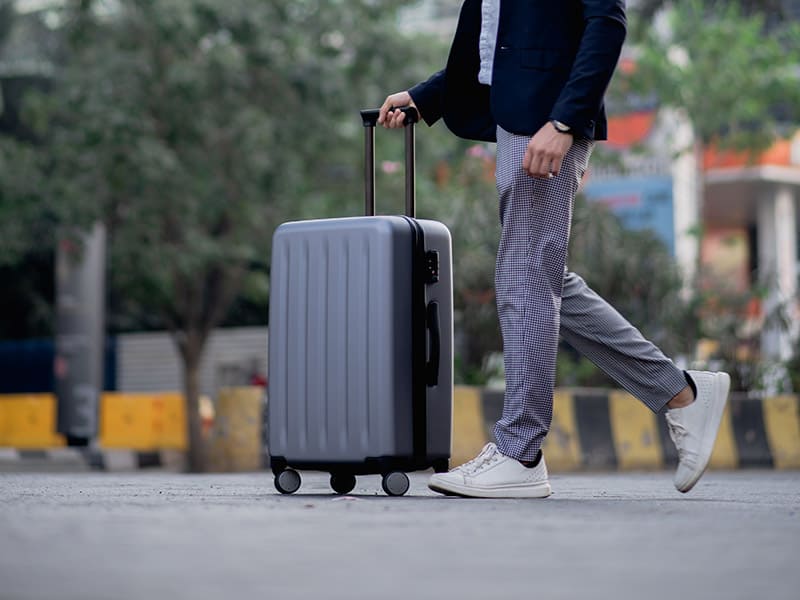
Spinner luggage has taken over airports in the last decade. Walk through any terminal and you’ll see way more four-wheel spinners than the classic two-wheel rollaboards your dad probably traveled with.
But “more popular” doesn’t mean “better for you.” Spinners win on smooth airport floors. Rollaboards win on cobblestones, durability, and packed volume. The right answer depends entirely on where you actually travel and how rough you are on luggage.
Here’s the full rollaboard vs spinner luggage breakdown so you can stop guessing.
Table of Contents
What Is a Rollaboard?
A rollaboard (also called upright, inline, rolling, or two-wheel luggage) has two larger wheels integrated into the back corners of the bag and a retractable handle on top. You tilt the bag at a 45-degree angle behind you and pull.
Because the wheels are recessed into the frame instead of sticking out, they’re harder to break off in baggage handling. The bigger wheel diameter also rolls over rough surfaces better than spinner wheels.
Rollaboards have been around since the 80s. Either Briggs & Riley or Travelpro invented them, depending on which historical account you trust. Before that, travelers literally carried suitcases. Wild.
What Is a Spinner?
A spinner has four wheels mounted on the bottom, each rotating 360 degrees. You stand the bag upright and push it next to you instead of tilting and pulling.
The trade-off: those four wheels stick out from the bag’s frame, which makes them significantly easier to break off. They also eat into the bag’s internal volume, since the wheel housings take up space that would otherwise hold clothes.
Some spinners come with double wheels (eight wheels total) for better durability and smoother handling on rough surfaces. Some premium brands also offer magnetic spinner wheels that lock straight when you tilt the bag, or spherical wheels that roll over uneven ground better. These are improvements but the fundamental tradeoffs still apply.
Rollaboard vs Spinner: How They Actually Compare

Here’s how each performs across the categories that actually matter.
Mobility on Different Surfaces
Spinners feel weightless on smooth airport floors. You push them next to you with one hand and they glide. On any surface that isn’t perfectly smooth, they get worse fast.
- Carpet (hotels, airports): Spinners win. The four-wheel design glides over carpet without dragging.
- Smooth tile or polished concrete: Spinners win by a lot. This is what they’re built for.
- Cobblestones (Europe, especially old towns): Rollaboards win. Spinner wheels get stuck between cobblestones constantly. Most spinner owners just carry the bag in this scenario.
- Gravel, dirt roads, brick paths: Rollaboards win. Larger wheels handle the bumps; spinner wheels stick.
- Cracked or torn asphalt: Mixed. Spinners struggle but don’t fail outright.
- Stairs: Tie. You’re carrying the bag either way.
- On a moving bus or train: Rollaboards win. Spinners roll around at every turn unless you have one with a brake button (rare).
The honest answer: if you almost always travel through modern airports and well-paved cities, spinners are easier. If you regularly hit cobblestones, gravel, or rough roads, rollaboards win.
Stability
Both can tip over. It depends on the specific model, not the wheel type.
Cheap spinners often place the wheels too close together, which makes the bag tippy. Cheap rollaboards have short plastic feet that don’t keep the bag stable when standing. Read reviews on the specific model before buying. A great rollaboard is more stable than a bad spinner and vice versa.
Weight
Spinners weigh more. Same model, same brand, the spinner version is typically 0.2 to 0.5 lbs heavier than the rollaboard equivalent.
That’s because four wheels with housings weigh more than two larger wheels plus two plastic feet. Doesn’t sound like much, but on a strict carry-on weight limit (Ryanair, Wizz Air, EasyJet), every ounce matters.
Example: the It Luggage World’s Lightest weighs 3.8 lbs as a [amazon link=”B07GWTGBHF” title=”rollaboard”] and 4 lbs as a [amazon link=”B07GX6K5P5″ title=”spinner”]. Tiny difference, but it’s consistent across brands.
Durability
Rollaboards are more durable, full stop. Two larger wheels recessed into the frame outlast four small wheels sticking out into the world.
Airline baggage handlers know this. Industry-wide, spinners get stacked on top of cargo holds because the wheels break easily. Rollaboards go on the bottom. Even with that careful handling, spinners still get more wheel damage in transit.
If you fly more than 20 times a year and check bags, get a rollaboard. The wheel breakage on spinners adds up fast.
Internal Volume
Same external dimensions, the rollaboard packs more. The spinner’s wheel housings eat 5-10 liters of interior space.
This matters more than people realize for carry-on. Airline carry-on size limits include the wheels and handles, so a 22-inch spinner has the same external footprint as a 22-inch rollaboard but holds noticeably less inside.
If you’re a tight packer trying to maximize carry-on capacity, rollaboards win.
Price
Spinners cost $10-$30 more than the rollaboard version of the same model. Two extra wheels, plus the housings and bearings, add manufacturing cost.
Factor in that spinner wheels break more often, even when covered by warranty you might pay shipping for repairs. Long-term, rollaboards are slightly cheaper.
Hooking Bags Together
If you’re traveling with multiple pieces and want to strap them together with luggage straps, spinners win. They roll as a single unit easily. Two rollaboards strapped together are awkward and tip easily.
Read next: Do Airlines Prefer Hard or Soft Luggage?
Should You Get a Rollaboard or Spinner?
Honest take based on traveler type:
- Business travelers: Spinner. You’re in airports and well-paved cities most of the time, and the bag rolls effortlessly next to you while you’re on a phone call or holding coffee.
- Occasional vacation travelers (1-3 trips a year): Spinner. Easier to use, looks more modern, and the lower durability won’t be a problem at low usage.
- Frequent travelers / digital nomads: Rollaboard. Durability matters more than maneuverability when you’re using the bag every month.
- Adventure travelers (cobblestones, gravel, off-the-grid): Rollaboard. Spinners will frustrate you within an hour.
- Kids: Spinner. Easier to push than pull. Less back strain.
- People with back problems: Spinner. The vertical pushing position avoids the spine torque that comes with pulling a tilted rollaboard.
- People who care most about packing volume: Rollaboard. More usable interior space.
Best Spinner Suitcases
[amazon link=”B07C2M7JRW” title=”Best Overall: Chester Minima 22-Inch Spinner”]
[amazon fields=”B07C2M7JRW” value=”thumb” image=”1″ image_size=”large” image_class=”image-layout-default” image_width=”250″ image_height=”250″]After testing 16+ luggage brands, Chester is consistently the best mid-tier option. The Minima is their flagship hardside spinner, and it’s worth the price.
The shell is polycarbonate (the most durable hardside plastic), and it’s backed by a 10-year warranty covering wheels, handles, and all functional defects. Double spinner wheels handle smooth and rough surfaces well. The wheels are also screwed in from the inside, so they’re easily replaceable.
Inside: TSA-approved combo lock, two-compartment main interior, removable laundry bag, and several internal pockets for organization. Minimalist design, no flashy “smart” features, just a really well-built bag.
[amazon link=”B07BL7JXHV” title=”Best Affordable: Travelpro Maxlite 5 21-Inch Spinner”]
[amazon fields=”B07BL7JXHV” value=”thumb” image=”1″ image_size=”large” image_class=”image-layout-default” image_width=”250″ image_height=”250″]The Maxlite 5 is the best spinner under $200, and it’s been my go-to recommendation for years. Travelpro sits second on our luggage brand leaderboard behind only Briggs & Riley.
It’s not the absolute cheapest spinner you can buy, but the durability difference at this price is huge. I’ve taken mine on dirt roads in Israel, and the wheels still look new. At 5.3 lbs, it’s also notably lighter than the average carry-on weight of 7.9 lbs.
Backed by Travelpro’s limited lifetime warranty. Spacious main compartment that expands if you need more room, plus exterior and interior pockets. The cheap $50 alternatives can’t touch its durability.
[amazon link=”B00XDIRKRC” title=”Best High-End: Briggs & Riley Baseline 22-Inch Spinner”]
[amazon fields=”B00XDIRKRC” value=”thumb” image=”1″ image_size=”large” image_class=”image-layout-default” image_width=”250″ image_height=”250″]Briggs & Riley is what flight crews and frequent travelers reach for when budget isn’t the question. The Baseline is their flagship.
Built from 1680D Ballistic Nylon (the most durable luggage fabric on the market) and backed by their unconditional lifetime warranty. No receipt needed, transferable between owners, and they’ll repair anything regardless of cause. That’s not marketing copy. They actually do this.
Smart features: built-in garment compartment for suits, signature CX compression/expansion system, externally mounted retractable handle that doesn’t eat interior space. Expensive, but it’ll last 20+ years. Worth it for travelers who fly 50+ times a year.
Best Rollaboard Suitcases
[amazon link=”B07DLB4766″ title=”Best Overall: Travelpro Platinum Elite 22-Inch Rollaboard”]
[amazon fields=”B07DLB4766″ value=”thumb” image=”1″ image_size=”large” image_class=”image-layout-default” image_width=”250″ image_height=”250″]Travelpro’s mid-tier business line. Worth every dollar for frequent flyers who want durability without paying Briggs & Riley prices.
Backed by Travelpro’s worry-free lifetime warranty. Built-in suiter compartment for suits/dresses. Expandable main compartment, removable TSA-approved toiletry pouch, advanced tie-down system, USB charging port with a dedicated power bank pocket.
If the Platinum Elite is out of budget, the [amazon link=”B01HD1ZUA8″ title=”Travelpro Crew 11 Rollaboard”] is the slightly stripped-down version with most of the same durability.
Full review: Travelpro Platinum Elite 25-Inch Checked Suitcase Review
[amazon link=”B07BLCB6DS” title=”Best Affordable: Travelpro Maxlite 5 22-Inch Rollaboard”]
[amazon fields=”B07BLCB6DS” value=”thumb” image=”1″ image_size=”large” image_class=”image-layout-default” image_width=”250″ image_height=”250″]The rollaboard cousin of the spinner I recommended above, and slightly better in every way except maneuverability.
Same Maxlite 5 line, same lifetime warranty, same ~$130-150 price range. The rollaboard version is 0.1 lbs lighter (5.4 lbs) and a bit roomier inside since there are no spinner wheel housings eating space.
Best affordable rollaboard on the market. Pay $80 less and you’ll get a bag that breaks within a year.
[amazon link=”B008M6ZD10″ title=”Best High-End: Briggs & Riley Baseline 22-Inch Upright”]
[amazon fields=”B008M6ZD10″ value=”thumb” image=”1″ image_size=”large” image_class=”image-layout-default” image_width=”250″ image_height=”250″]Same Briggs & Riley Baseline as above, just in rollaboard form. Slightly more interior space, slightly more durable, slightly cheaper than the spinner version.
Same 1680D Ballistic Nylon, same unconditional lifetime warranty, same built-in suiter and CX expansion. The handle is mounted externally so it doesn’t eat interior space.
Only worth the price if you’re flying 5-10+ times a year. For everyone else, the Travelpro Platinum Elite gets you 90% of the way there at half the cost.
Final Take on Rollaboard vs Spinner
If you’re flying mostly modern airports and walking on smooth pavement, get a spinner. The maneuverability is genuinely better and you won’t notice the durability hit at moderate use.
If you’re flying often, traveling rough, packing tight, or doing both, get a rollaboard. The bigger wheels, recessed mounting, and extra interior volume add up.
If you’re undecided, get the spinner. Most travelers are better served by easier handling than by maximum durability, and the price gap is small enough that you can replace a spinner once or twice over the lifetime of a single rollaboard and still come out roughly even.