


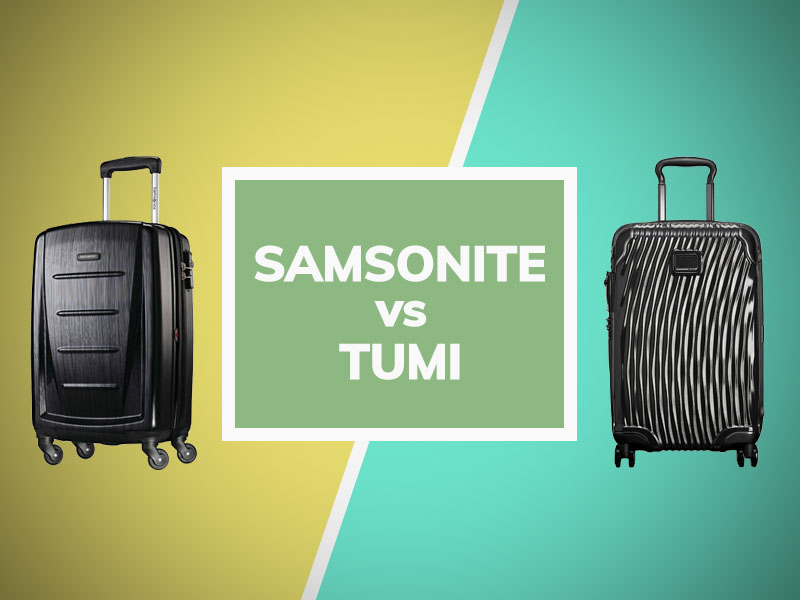
Tumi makes better luggage than Samsonite, but it’s not worth the price difference for most travelers. Tumi bags last 10+ years and have premium features. Samsonite bags last 3-7 years with lighter weight and cost about 1/5th the price. For most people, Samsonite’s value math wins. But if you’re a weekly business traveler who needs one bag to survive serious miles, Tumi earns its cost.
Here’s the full breakdown: durability, weight, sizing, warranty, features, and the best model from each brand, plus an honest verdict on who should actually buy which.
Table of Contents
Quick Summary: Samsonite vs Tumi
Samsonite: Founded in 1910. The largest luggage brand in the world by sales. Targets leisure and business travelers in the mid-range price category. Makes suitcases, backpacks, duffel bags, and travel accessories. Wide retail presence – most cities have an authorized dealer where you can handle bags before buying.
Tumi: Founded in 1975. Actually owned by Samsonite since 2016, now accounting for roughly 45% of Samsonite’s total sales volume. Targets frequent and business travelers who want premium durability and features. Makes suitcases, garment bags, backpacks, and accessories. Priced 5x higher than Samsonite on average.
Weight: Samsonite Is Significantly Lighter

Tumi luggage is 36% heavier than Samsonite on average. That’s the direct cost of the thicker, more durable materials Tumi uses. Across 32 luggage brands ranked by weight, Tumi placed last (heaviest of all), while Samsonite ranked 11th. Samsonite’s closest volume competitor, Delsey Paris, scored 25th.
The most lightweight Samsonite option is the [amazon link=”B06Y4DY87B” title=”Samsonite Base Boost”], which weighs 4.4 lbs (2.0 kg). That’s about 1/3 lighter than the average carry-on in its size category.
If you fly budget airlines, especially in Europe where weight limits can be as strict as 7 kg for carry-on, Samsonite is the safer choice. Tumi’s weight often eats into your clothing allowance before you’ve packed a single item.
Read Next: Samsonite vs American Tourister: Which One Is Better?
Durability: Tumi Wins by a Wide Margin
Tumi’s durability advantage is real. Their softside bags use ballistic nylon, which is the most durable softside fabric on the market. Their hardside bags use polycarbonate and aluminum, and they’ve introduced two proprietary materials (Tegris and FX Ballistic) made from woven polypropylene that match polycarbonate strength at lower weight.
Samsonite uses polyester for most softside bags and polycarbonate or polypropylene for hardside. These are solid mid-range materials, but a step below Tumi’s build quality.
Expected lifespan in practice:
- Samsonite: 2 to 5 years with heavy use, 10+ years with occasional travel
- Tumi: 10+ years even with heavy weekly use
Customer reviews confirm this pattern. Tumi complaints are almost never about structural durability. They’re about warranty terms, minor design choices, and pricing. Samsonite reviews include a meaningful number of complaints about broken wheels, cracked shells, failed zippers, and loose stitching. None of these are common, but they show up more often than with Tumi.
Size: Tumi Fits Airline Limits Better
This is a real differentiator. Looking at the most common US carry-on limit of 22 x 14 x 9 inches:
- Tumi: All carry-on models reviewed fit within this limit
- Samsonite: None of the carry-on models reviewed fit within this limit. Average overage is 1.81 inches (4.6 cm)
For checked luggage (62 linear inch limit), only one Samsonite large checked bag cleared the limit. All of Tumi’s checked large bags cleared it.
This matters on budget carriers and flights where gate agents are measuring bags. Most travelers don’t get caught, but it’s a real risk if you fly Southwest, Spirit, or international budget carriers regularly.
Customer Reviews: Samsonite Rated Higher
Counterintuitively, Samsonite outscores Tumi on customer reviews. Samsonite averages 4.64 stars vs Tumi’s 4.29 stars, ranking 11th vs Tumi’s 28th out of 32 brands tracked. The reason: Tumi’s pricing sets an expectation of perfection, and anything less than perfect becomes a negative review. Small design flaws and warranty friction that would be ignored on a $200 bag get called out sharply on a $1,000 one.
Read Next: Ricardo Beverly Hills vs Samsonite Luggage
Features: Tumi Has the Full Package
Samsonite feature highlights
- TSA-approved combination locks on almost all models, including softside
- USB charging ports on select high-end models
- Expandable zippers on most bags (adds 1 to 2 inches)
- Simple interior layout with a divider sheet, a pocket, and tie-down straps. Good for packing cubes, basic otherwise.
- Single or double spinner wheels depending on the model tier
Tumi feature highlights
- Tumi Tracer — a 20-digit code on the exterior that lets anyone contact Tumi if the bag is lost. Anonymized, no personal info visible.
- Suiter compartments — most Tumi bags have hanger brackets or dedicated garment sleeves. A real benefit for business travelers packing suits.
- Double spinner wheels (eight total) on all models. Tighter cornering and longer roll life than standard four-wheel spinners.
- Dual-access main compartment on select models — lets you access the main compartment without fully opening the bag.
- Omega Closure zippers — designed to separate from the bag cleanly if caught on a conveyor belt, protecting the zipper track from the damage that ruins most suitcases.
- Advanced expansion systems — the [amazon link=”B01N7MYSQA” title=”19-degree aluminum”] uses a latch-based expansion rather than a zipper, which lets you pack more while reducing garment wrinkles.
- Interior and exterior luggage tags on all models
- TSA-approved combination locks and USB charging ports
Read Next: Tumi vs Away Luggage: Which One Should You Get?
Price: The Biggest Gap

Tumi bags cost 456% more than Samsonite on average. For the price of one Tumi bag, you could buy five Samsonite bags.
The value math on Tumi doesn’t hold up for most travelers. A $1,000 Tumi bag that lasts 15 years costs about $67/year. A $200 Samsonite bag that lasts 5 years costs $40/year. Even if your Samsonite only makes it 3 years, you’re still ahead. The only scenario where Tumi wins the math is if you’re a heavy weekly traveler where Samsonite’s durability drops well below 3 years.
Worth noting: for $500 to $700, you can get a Briggs & Riley bag with equal durability to Tumi, better features, and an unconditional lifetime warranty. That makes Tumi’s $1,000 price point hard to defend.
Warranty: Tumi’s First Year Is Excellent, Then It Drops Off
Samsonite offers a 10-year warranty. Tumi offers a 5-year warranty. Despite the longer number, Samsonite’s warranty is actually narrower in coverage.
The breakdown:
- Tumi Year 1: All defects covered, including shipping. Essentially unconditional.
- Tumi Years 2-5: Manufacturing defects only. You pay return shipping. Accident damage, transport damage, and wear and tear aren’t covered.
- Samsonite 10-year: Manufacturing defects only, throughout. Samsonite pays return shipping but you can also hand off to any authorized dealer.
Neither matches Briggs & Riley’s unconditional lifetime warranty, which covers any defect that makes the bag unusable, forever, including damage from airline handling. Tumi used to offer lifetime coverage before being acquired in 2016. That ended with the acquisition.
Verdict: Which Brand Should You Buy?
Buy Samsonite if: You travel occasionally to regularly, want a reliable bag without paying a luxury premium, and don’t need specialized business travel features like suiter compartments. The value math strongly favors Samsonite for anyone who isn’t flying weekly.
Buy Tumi if: You fly several times per week, need the suiter compartments and Tracer feature, and work for a company that subsidizes or reimburses business travel gear. At that usage level, the durability advantage starts justifying the cost.
But honestly? Look at Briggs & Riley first. For $500 to $700, you get Tumi-level durability, better features, and an unconditional lifetime warranty that covers airline-induced damage. Their [amazon link=”B00XDIRKRC” title=”Baseline carry-on”] is the best bag for serious travelers at any price, and it costs less than most Tumi models. See our full Briggs & Riley vs Tumi comparison for the side-by-side.
For mid-range shoppers, Travelpro is worth a look before committing to Samsonite. Travelpro runs about 15% more expensive but scores better on durability, features, and customer reviews. Their [amazon link=”B07BM9DFX9″ title=”Maxlite 5″] is the entry-level pick, and the [amazon link=”B07QW9LMRT” title=”Versapack”] is worth the step up if you travel more than a few times per year.
Best Bags From Each Brand
Best Samsonite Softside: Base Boost
The [amazon link=”B06Y4DY87B” title=”Samsonite Base Boost”] is Samsonite’s best lightweight carry-on. At 4.4 lbs (2.0 kg), it’s nearly 1/3 lighter than the average softside carry-on and sized to meet European budget airline restrictions (55 x 40 x 20 cm).
It’s not as durable as heavier Samsonite models (built from polyester, not nylon), but it holds up to moderate travel well. Stick with the inline wheel version over the spinner version for better durability. Interior is spacious and minimal, which pairs well with packing cubes. Expected lifespan: 3 to 5 years with regular use.
Best Tumi Softside: Alpha 3 Dual Access
The [amazon link=”B07MQWFCHC” title=”Tumi Alpha 3″] is the most durable softside carry-on we’ve reviewed across any brand. Built from ballistic nylon with reinforced handles, wheels, and Omega zippers. Sized to fit most international and US domestic overhead bins. Comes with USB port, TSA lock, expandable zipper, suiter compartment, and dual-access front zipper.
The main drawback: 10.07 lbs (4.56 kg). That’s 54% heavier than the average softside carry-on and will cause issues on strict budget airlines. Used weekly, it should last 10+ years. If you can live with the weight and price, it’s the best softside bag on the market.
Best Samsonite Hardside: Omni PC
The [amazon link=”B01M4F9J2V” title=”Samsonite Omni PC”] is Samsonite’s best seller. Built from polycarbonate (the most durable luggage plastic), weighing 6.81 lbs. Slightly over the standard 22 x 14 x 9 inch carry-on limit, so expect occasional pushback on strict airlines.
Features: TSA lock, expandable zipper, spinner wheels, scratch-resistant coating. Interior is simple but spacious. The handles are the weak point — a number of reviews flagged them as flimsy. If the handles matter to you, step up to a different model. With occasional use, expect 5 to 10 years. A solid value at the price.
Best Tumi Hardside: Latitude
The [amazon link=”B0793NBJF8″ title=”Tumi Latitude”] is Tumi’s best plastic hardside carry-on. Sized correctly for most airline limits. Weighs 6.22 lbs (2.82 kg), about 10% lighter than the average plastic hardside carry-on in this size. Features include TSA lock, double spinner wheels, suiter sleeve slot, Tumi Tracer, interior and exterior luggage tags, and a two-section main compartment.
In honest terms: the Latitude is well-built but not dramatically more durable than the Samsonite Omni PC for the significant price difference. If you want the Tumi features (Tracer, suiter slot, brand reputation) and the price isn’t a concern, it’s a good bag. Otherwise, the [amazon link=”B01M4F9J2V” title=”Omni PC”] gives you 80% of the bag for 20% of the price.
Samsonite vs Tumi: Frequently Asked Questions
Is Tumi worth the price over Samsonite?
For most travelers, no. Tumi costs 5x more but the durability advantage only pays off if you fly heavily (multiple times per week). Occasional to regular travelers will save money buying Samsonite bags every few years rather than paying Tumi’s premium once. The exception is the Briggs and Riley comparison: for $500-700, you get Tumi-level durability with a better warranty, which is the actual sweet spot.
Is Samsonite or Tumi better for business travel?
Tumi, if your employer covers the cost. The suiter compartments, Tumi Tracer, double spinner wheels, and Omega zippers are genuinely useful for frequent business travelers. If you’re paying out of pocket, Briggs and Riley gives you the same durability and better warranty terms for about half the price of comparable Tumi models.
Who owns Tumi?
Samsonite. They acquired Tumi in 2016 to expand into the premium travel segment. Tumi now accounts for roughly 45% of Samsonite’s total sales volume. Despite common ownership, the two brands are operated separately and their products are meaningfully different in materials, features, and pricing.
Which brand has better sizing for airline carry-on restrictions?
Tumi. All Tumi carry-on models reviewed fit within the standard US carry-on limit of 22 x 14 x 9 inches. None of the Samsonite carry-on models reviewed met this limit, averaging 1.81 inches over. This matters mainly on budget airlines and international carriers with strict enforcement.
Does Samsonite make lighter luggage than Tumi?
Yes, significantly. Tumi averages 36% heavier than Samsonite, ranking last (heaviest) among 32 luggage brands tracked. Samsonite ranks 11th. The weight difference is the direct result of Tumi’s thicker, more durable materials. For budget airline travel, Samsonite’s lighter weight gives you more room to pack.
Which has a better warranty: Samsonite or Tumi?
Tumi’s first year is significantly better: all defects covered including shipping, essentially unconditional. Years 2-5, only manufacturing defects, and you pay shipping. Samsonite offers a 10-year warranty on manufacturing defects. Neither matches Briggs and Riley’s unconditional lifetime warranty, which is the best in the industry.
See all our luggage brand comparisons and reviews to find the right fit for your travel style.