


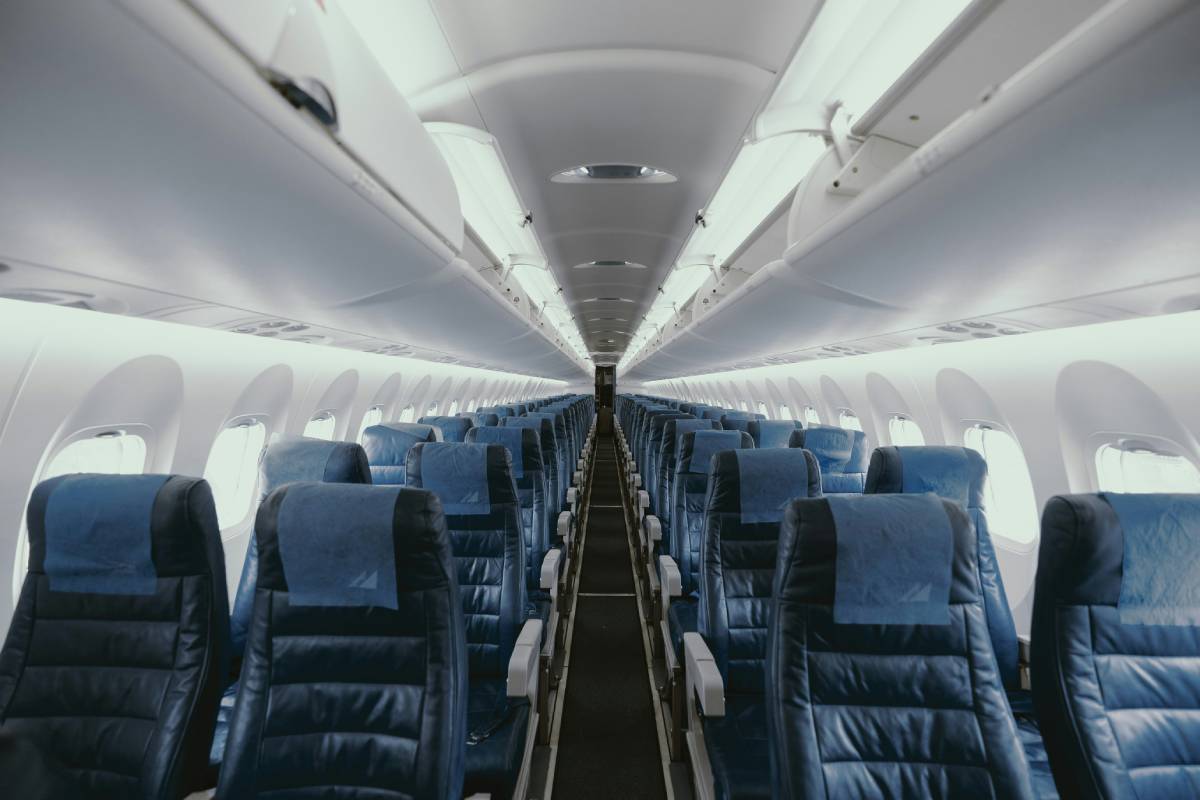

Seat C on a plane is almost always an aisle seat, but the specific location depends on the plane’s configuration. On the most common narrow-body aircraft (3+3 layout like a Boeing 737 or Airbus A320), seat C is on the left side of the plane, in the middle of the three-seat block, which puts it at the aisle. On wide-body planes with different layouts, seat C’s position shifts.
Table of Contents
Seat C on Common Aircraft Layouts
Narrow-body: 3+3 layout (Boeing 737, Airbus A319/A320/A321)
Standard seating goes A-B-C | D-E-F. Seat C is the aisle seat on the left side. Seat D is the aisle seat on the right. This is the layout on most domestic US flights.

Wide-body: 2+4+2 layout (Boeing 767, some Airbus A330s)
Seats go A-B | C-D-E-F | G-H. In this configuration, seat C is the aisle seat on the left side of the center block. You’re in the middle section, with the aisle to your left. This is a good seat if you want aisle access and don’t mind being in the center section.
Wide-body: 3+3+3 layout (Boeing 777)
Seats go A-B-C | D-E-F | G-H-J (note: no I). Seat C is the aisle seat on the left block. This is equivalent to the 737 layout but with an extra center section.
Wide-body: 3+4+3 layout (Boeing 747, Airbus A380 economy)
Seats go A-B-C | D-E-F-G | H-J-K. Seat C is still the aisle seat on the left three-seat block. You’re on the left side of the plane with the aisle to your right.
The consistent principle: seat C is always near the aisle, and on the left side of the cabin. Airlines use alphabetical lettering that skips I (to avoid confusion with the number 1), so the right side of a 3+3 plane has seats D, E, and F rather than D, E, and I.
Is Seat C a Good Seat?
As an aisle seat, C has the standard aisle advantages and trade-offs:
- Pros: Easy to get up without climbing over people, easier access to overhead bins, can stretch one leg into the aisle, off the plane faster on arrival
- Cons: People sitting next to you (seats A and B) will need to get past you throughout the flight, more foot traffic from the cabin aisle, leaning against the window is not an option
C is a better aisle seat than D on most aircraft because the left side of the plane typically has the galley farther away and sees slightly less traffic on many routes. That said, this varies by aircraft and airline configuration.
For the best version of seat C on a given flight, check SeatGuru.com for your specific aircraft. Some C seats are exit row seats (extra legroom, though with restrictions), and some C seats in bulkhead rows have fixed arm rests that limit the middle seat. SeatGuru color-codes seats by quality so you can see which row’s seat C is worth selecting.
Seat C in Business and First Class
In business and first class, the seating configuration is completely different. Business class on long-haul flights often uses a 1+2+1 or 2+2+2 layout, which assigns letters differently. On a 1+2+1 layout, you might have A | C-D | H (skipping letters to maintain consistency with economy), and seat C would be one of the center pair rather than an aisle seat. Always check the seat map for premium cabins.
How to Guarantee Seat C
Seat C books out quickly on popular routes because aisle seats are in demand. Strategies:
- Select your seat at booking if your fare allows it (most airlines charge extra for seat selection on basic economy tickets)
- Check in online the moment check-in opens (usually 24 hours before departure). Unclaimed preferred seats get released at that point.
- Ask the gate agent if the seat is available when boarding. Gate agents sometimes move passengers to accommodate families or fill premium seats, which opens other seats.
Frequently Asked Questions About Seat C
Is seat C always an aisle seat?
On most aircraft, yes. On narrow-body planes with a 3+3 layout (Boeing 737, Airbus A320), seat C is the aisle seat on the left side. On wide-body planes, C is still typically near the aisle, but the exact position depends on the cabin layout. Check the seat map for your specific flight.
Is seat C on the left or right side of the plane?
Left side. Standard lettering goes A-B-C on the left, D-E-F on the right (on a 3+3 layout). C is always on the left side in a three-seat block, at the aisle. Wide-body planes with center sections still keep C on the left side.
Is seat C or D better on a plane?
Both C and D are aisle seats on most narrow-body aircraft. Neither is definitively better. It comes down to whether you prefer the left or right side of the plane. The left side (C) sometimes has the galley farther away, which means slightly less foot traffic from flight attendants, but this varies by aircraft and airline.
What does seat letter C mean on different planes?
On most planes, C means aisle seat, left side. On some wide-body planes with a 2+4+2 layout, C is the aisle seat of the center four-seat block. In business class, the letters are often renumbered and C may not be an aisle seat. Always check SeatGuru.com for your specific aircraft layout.
Why do airplane seats skip the letter I?
Aircraft seat numbering skips I to prevent confusion between the letter I and the number 1 on boarding passes and seat maps. The sequence typically goes A, B, C, D, E, F, G, H, J, K (for wider aircraft).
Is seat C a good seat for tall people?
As an aisle seat, C lets you extend one leg into the aisle when the cart isn’t going by, which helps. For maximum legroom, look for exit row seats or bulkhead seats. Check whether the C seat in those rows has any restrictions, since some bulkhead seats have fixed arm rests that eliminate under-seat storage.